
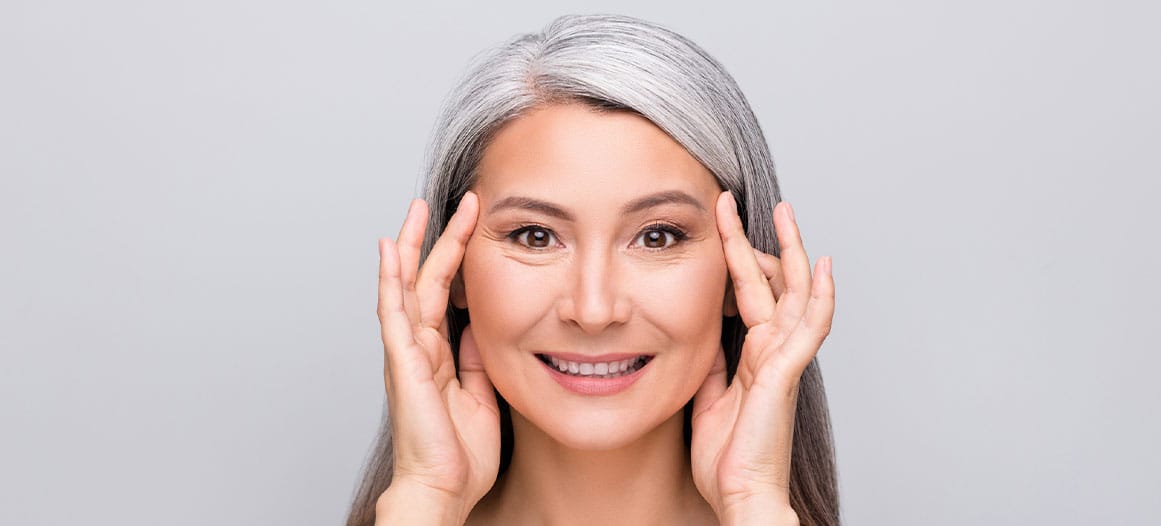
You catch your reflection during a video call and notice what wasn’t there a few years ago: looser skin along your jawline, flattening in your cheeks, deeper folds beside your mouth. You still feel like yourself, but your face looks more tired than you’d like. At the Center for Eye and Facial Plastic Surgery in New Jersey, Dr. Deepak Ramesh, our fellowship-trained oculofacial plastic surgeon, offers advanced facelift techniques, including the ponytail facelift, to help you choose the right approach based on your anatomy, aging patterns, and long-term goals.
Overview
Ponytail facelift
A ponytail facelift is a less invasive lifting technique that creates a subtle, refreshed look, similar to the gentle lift you see when your hair is pulled back tightly. It typically focuses on the upper and midface, especially the temples, outer brows, and cheeks. The incisions are usually small and hidden within the hairline. This approach offers refined enhancement rather than dramatic structural change and is best suited for early signs of facial aging.
Traditional facelift
A traditional facelift, or rhytidectomy, is a surgical procedure that addresses bigger aging changes in the midface, jawline, and neck. It involves repositioning the underlying SMAS layer, the structural support system beneath the skin, along with removing excess skin. This allows for more significant correction of sagging, jowls, and loose neck tissue. The result is a smoother, firmer, and more youthful contour that treats both surface and deeper anatomical changes.
Scars
Ponytail facelift
Because it uses smaller incisions placed within the hairline, scarring from a ponytail facelift is generally minimal. The limited surgical exposure reduces any visible marks, which appeals to patients concerned about detectable signs of surgery. However, incision placement and healing vary based on individual anatomy and technique, so careful surgical planning remains critical.
Traditional facelift
A traditional facelift requires longer incisions that typically follow natural contours around the ears and extend into the hairline. While these scars are strategically placed and fade over time, they are more extensive than those used in a ponytail lift. When performed meticulously, scars are discreet, but the procedure inherently involves greater surgical access.
Recovery
Ponytail facelift
Recovery from a ponytail facelift is generally shorter. Many patients return to normal activities within one to two weeks, with milder swelling and bruising. Because the surgery is less invasive, downtime is reduced. However, you should still expect temporary tightness and swelling, and you will need to follow detailed postoperative instructions to optimize healing.
Traditional facelift
A traditional facelift typically requires two to four weeks of recovery. You may also notice more pronounced swelling and bruising, and may need additional time before feeling socially ready. While recovery demands more patience, the tradeoff is a more comprehensive correction and longer-lasting structural improvement.
Longevity
Ponytail facelift
The results of a ponytail facelift often last several years, typically in the three-to-five-year range, depending on skin quality and lifestyle. Because it does not significantly reposition deeper facial structures as a traditional facelift does, its effects are more subtle and shorter-lived.
Traditional facelift
A traditional facelift offers more durable results, frequently lasting a decade or longer. Lifting and securing the deeper SMAS layer creates structural support that ages more gracefully over time. Although aging continues, you maintain a more youthful baseline for many years.
Who it’s for
Ponytail facelift
This option may suit you if you are in your 30s or 40s with mild to moderate sagging and good skin elasticity. It is ideal if you want a refreshed look without a dramatic change and prefer shorter downtime. It is not meant for significant skin laxity or advanced jowls.
Traditional facelift
A traditional facelift is often appropriate if you are experiencing moderate to severe sagging in your 40s, 50s, 60s, or beyond. If you have prominent jowls, deeper folds, or loose skin and want meaningful, long-term improvements, this procedure provides more comprehensive correction.
Verdict: Which is better? And is it worth it?
A ponytail facelift can be worthwhile if your concerns are early and you want subtle corrections with minimal downtime. It offers refinement, not transformation, and can delay the need for more extensive surgery. A traditional facelift is generally the better choice for advanced aging and for patients seeking lasting, structural rejuvenation.
Ultimately, the “better” procedure depends entirely on your anatomy, goals, and expectations. At the Center for Eye and Facial Plastic Surgery, Dr. Ramesh leverages his advanced oculofacial expertise to recommend the approach that aligns with your face and your future. Contact us today to schedule your consultation.